One of the most misunderstood rules in the Federal Employees Retirement System is what happens when you retire at your Minimum Retirement Age with between 10 and 29 years of service. Most federal employees know they can retire at MRA with 10 years. What many don't realise until it's too late is that their pension gets reduced by 5% for every year they're under age 62 at retirement — permanently.
What is your Minimum Retirement Age?
Your MRA depends on your year of birth:
| Birth year | MRA |
|---|---|
| Before 1948 | 55 |
| 1948 | 55 years, 2 months |
| 1949 | 55 years, 4 months |
| 1950 | 55 years, 6 months |
| 1951 | 55 years, 8 months |
| 1952 | 55 years, 10 months |
| 1953–1964 | 56 |
| 1965 | 56 years, 2 months |
| 1966 | 56 years, 4 months |
| 1967 | 56 years, 6 months |
| 1968 | 56 years, 8 months |
| 1969 | 56 years, 10 months |
| 1970 or later | 57 |
The reduction in real numbers
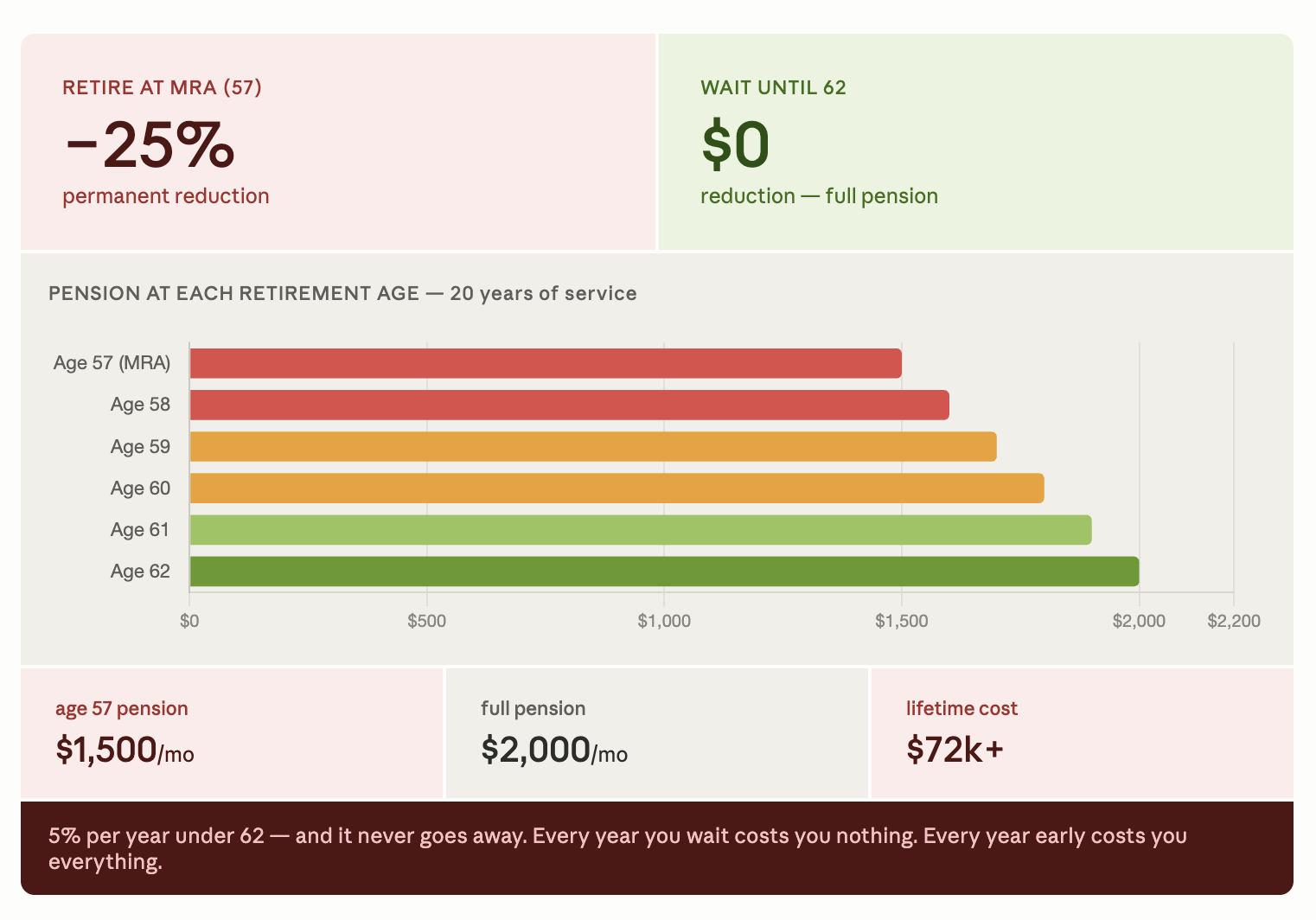
Say your MRA is 57 and you retire at 57 with 15 years of service. You are 5 years under age 62. The reduction is 5% × 5 = 25% — permanently.
If your unreduced pension would have been $2,000/month, after the MRA+10 reduction you receive $1,500/month for the rest of your life. That $500/month gap never closes. It is not a temporary penalty that phases out — it is a permanent reduction to your annuity.
The table below shows how the reduction compounds at different retirement ages for someone with an MRA of 57:
| Retire at | Years under 62 | Reduction | Pension (if unreduced = $2,000) |
|---|---|---|---|
| 57 | 5 | 25% | $1,500/mo |
| 58 | 4 | 20% | $1,600/mo |
| 59 | 3 | 15% | $1,700/mo |
| 60 | 2 | 10% | $1,800/mo |
| 61 | 1 | 5% | $1,900/mo |
| 62 | 0 | 0% | $2,000/mo |
The FERS Supplement does not apply
This is the second punch that many MRA+10 retirees don't see coming.
The FERS Special Retirement Supplement bridges the income gap between your retirement date and age 62, when Social Security can begin. It is paid to FERS employees who retire under immediate unreduced retirement — MRA with 30+ years, age 60 with 20+ years, or age 62 with 5+ years.
MRA+10 retirees do not receive the supplement. So you face both a reduced pension and no supplement income during the years before Social Security.
The three FERS retirement paths at MRA
Understanding the difference between these paths is the most important thing you can do before making a retirement decision:
Path 1: Immediate full retirement (MRA + 30 years) Full pension, no reduction, FERS Supplement until 62. This is the gold standard path. If you're close to 30 years, working a little longer is almost always worth it.
Path 2: MRA+10 (MRA with 10–29 years, retire immediately) Reduced pension, no supplement. You get income now but permanently sacrifice a portion of your pension.
Path 3: Postponed retirement (MRA with 10+ years, delay claiming) You separate from federal service at MRA but do not immediately claim your pension. You delay the claim to a later age — reducing or eliminating the 5% per year penalty. At age 62 the penalty is gone entirely.
The catch with postponed retirement: you lose FEHB (Federal Employees Health Benefits) coverage during the gap unless you can get on a spouse's plan or pay COBRA rates. For many employees, this is the deciding factor.
The break-even calculation
If you're choosing between MRA+10 (take the reduced pension now) and postponed (wait for the full pension), the break-even is the age at which the cumulative income from postponed retirement surpasses the cumulative income from early reduced retirement.
Example:
- Unreduced pension: $2,000/month
- MRA+10 pension at age 57: $1,500/month ($500/month less)
- If you wait until 62 to claim: you forgo $1,500/month × 60 months = $90,000 in payments
- But you gain $500/month more starting at 62
- Break-even: $90,000 ÷ $500 = 180 months = 15 years after 62 = age 77
If you expect to live past 77, postponed retirement wins on lifetime income. If you have health concerns or need the income, MRA+10 may be the right choice. This isn't a math problem with one right answer — it's a personal decision that depends on your health, your other income sources, and whether you can maintain health coverage.
What to do if you're approaching your MRA
-
Get your official pension estimate from HR. Ask for the estimate at your planned retirement date and also at age 62. The difference tells you the exact dollar cost of retiring early.
-
Model the break-even. Use your specific numbers to calculate the crossover age. If it's 80+, MRA+10 looks more attractive. If it's 72, waiting likely wins.
-
Check your FEHB situation. Can you get on a spouse's plan? Can you afford COBRA? This often determines whether postponed retirement is even viable.
-
Consider the 30-year threshold carefully. If you're at 27 years and MRA, three more years of service eliminates the penalty entirely and gives you the supplement. The math on staying 3 more years is often very compelling.